Designers
Qiqi Zhao, Qinwen Feng
Year
2026
Category
Concept
Country
United States
Design Studio / Department
Product Design
Three questions to the project team
What was the particular challenge of the project from a UX point of view?
The core UX challenge was designing a system that feels powerful yet invisible to older adults. Our users have mild cognitive or hearing decline, low digital confidence, and prefer physical cues over screens, so every interaction had to be stripped to its essence, no menus, no clutter, no decision fatigue. The difficulty was balancing AI automation with user control, creating a workflow that is helpful without feeling intrusive, and ensuring emotional clarity across distance.
What was your personal highlight in the development process? Was there an aha!-moment, was there a low point?
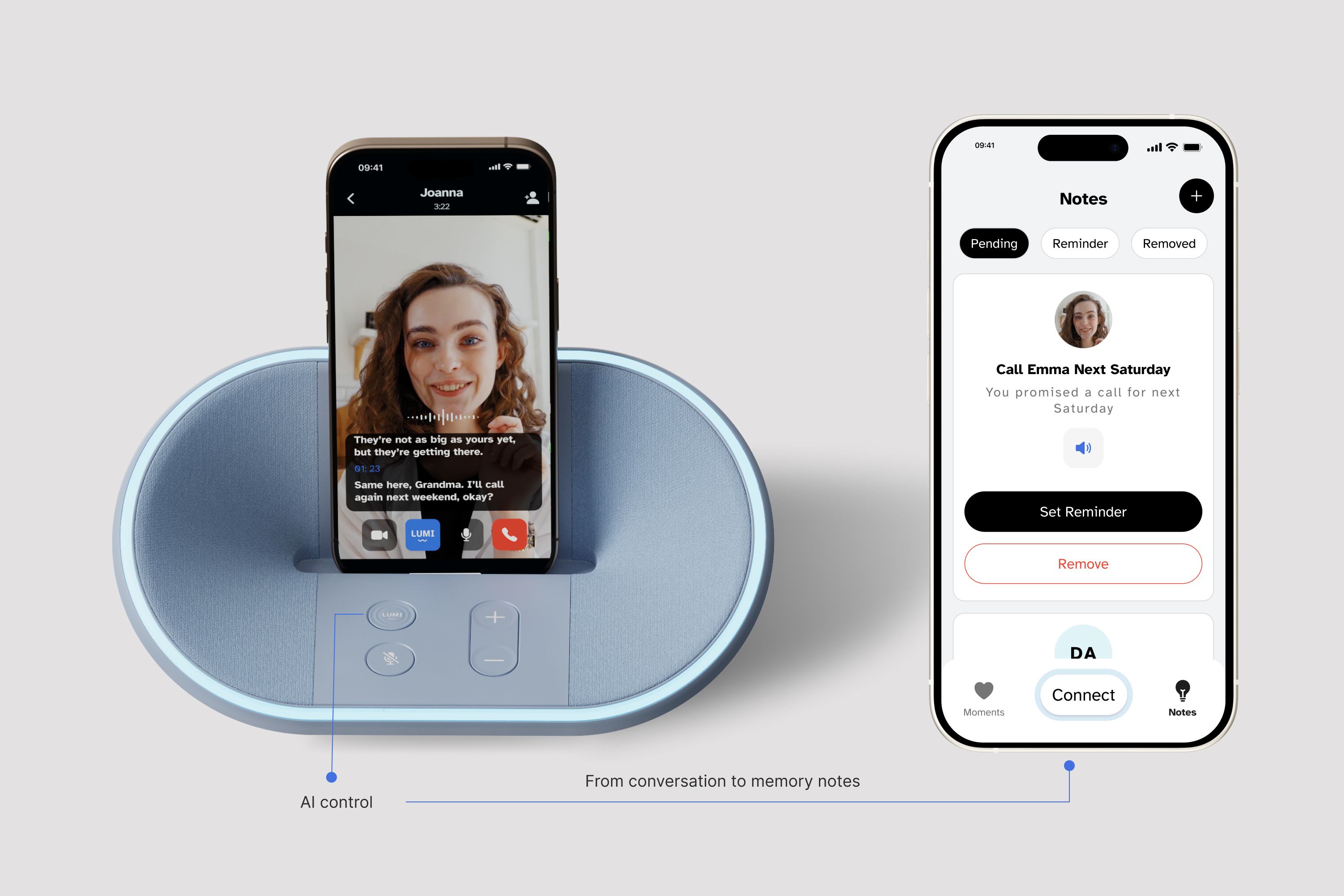
Our aha-moment came from exploring how seniors could regain confidence during conversations. Early in testing, we tried having the AI handle everything: listening, capturing, and summarizing. But we found that when the AI takes over entirely, it weakens seniors’ ability to form memory and reduces engagement. The AI should not replace their memory, but serve as a high-level assistant they can consciously engage with.
We shifted to designing memory cues-the visual posts that transform important moments from a call into glanceable prompts. These cues give seniors just enough structure to follow up and just enough control to activate their own memory. Finding this delicate balance was the most meaningful breakthrough in the project.
Where do you see yourself and the project in the next five years?
In five years, we see Lumi becoming a trusted companion for the rapidly growing aging population in the U.S., expanding from family communication to broader community support, including neighbors, caregivers, and local services. As AI matures, Lumi will provide richer context, safer independence, and deeper emotional presence. For us, this project is a foundation for building AI that strengthens real-life relationships rather than replacing them.