Designers
Xuan Zhu, Yating Dong, Jiawen Yu, Yiren Wang, Yawen Tan, Meixi Wang
Year
2026
Category
New Talent
Country
China
School
Goldsmiths, University of London
Teacher
Dr. Rabail Tahir
Three questions to the project team
What was the particular challenge of the project from a UX point of view?
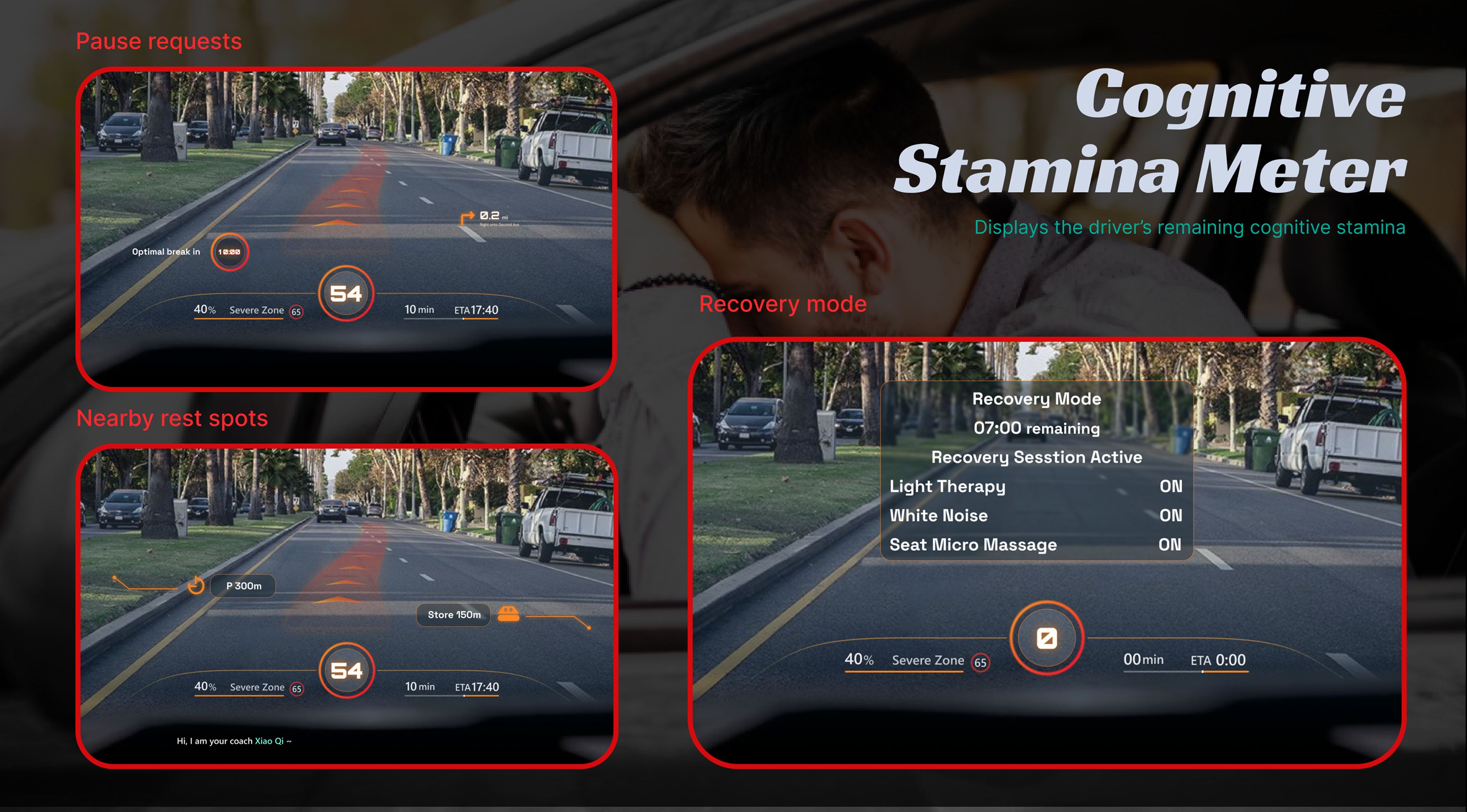
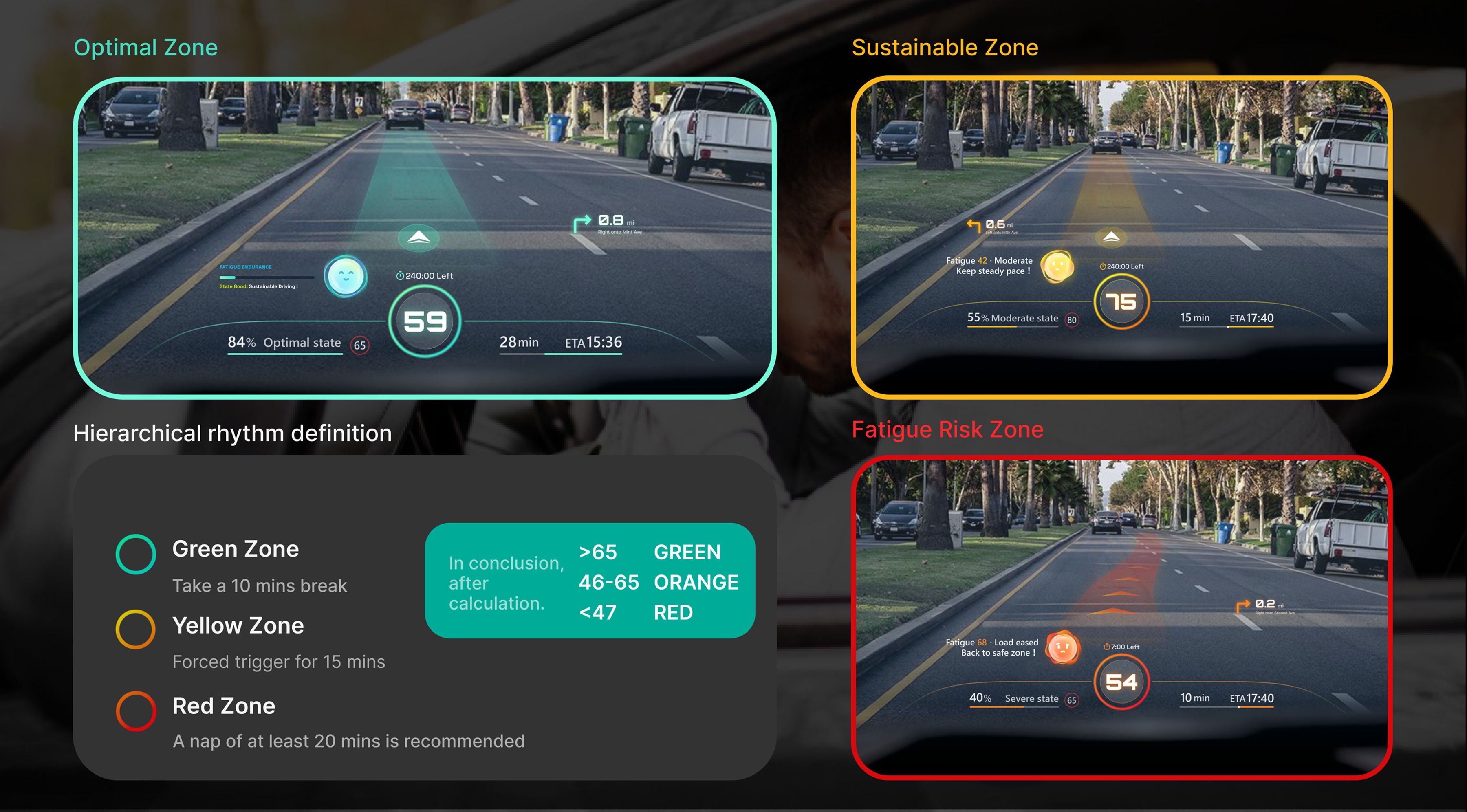
From a user experience perspective, the project faces several key challenges. We designed a three-level fatigue alert system (green, yellow, and red) in the AR driving interface. The first challenge is to ensure warnings are clear. Full-time ride-hailing drivers often face income pressure and are reluctant to stop working when fatigue first appears. The system only triggers mandatory rest and order-suspension reminders at the red, high-risk fatigue level. To support users with different visual needs, we also provide adjustable alert intensity and high-contrast display modes. In addition, local data processing and anonymization are used to protect privacy and build user trust.
What was your personal highlight in the development process? Was there an aha!-moment, was there a low point?
One of the most memorable moments during development was testing with a driving simulator. Our first prototype was too cluttered, with excessive information and visual elements that distracted drivers and even blocked their view. Test users reported higher cognitive load and reduced driving comfort. We realized the design did not fit real driving conditions. To improve it, we removed unnecessary content, simplified the layout, resized controls, and reorganized information by priority. The redesigned interface became cleaner, lighter, and no longer obstructed the driver’s view. This experience taught us that in-vehicle interaction design must prioritize visibility and minimize cognitive load.
Where do you see yourself and the project in the next five years?
In the future, I will focus fully on human-vehicle interaction product design. For the Driveletics project, we will continuously polish prototypes based on test feedback and carry out in-depth algorithm iteration to make fatigue detection and graded intervention more accurate. We plan to cooperate with major ride-hailing platforms and automobile manufacturers to promote and apply this system widely. We aim to set a new industry benchmark for driver fatigue management. In the long run, we hope the project can improve road safety across the whole mobility industry and drive the development of intelligent human-vehicle interaction.