Designers
Seohyun Choi, Juhee Im
Year
2026
Category
New Talent
Country
Korea, Republic
School
Seoul National University
Teacher
Yeongchan Jung
Three questions to the project team
What was the particular challenge of the project from a UX point of view?
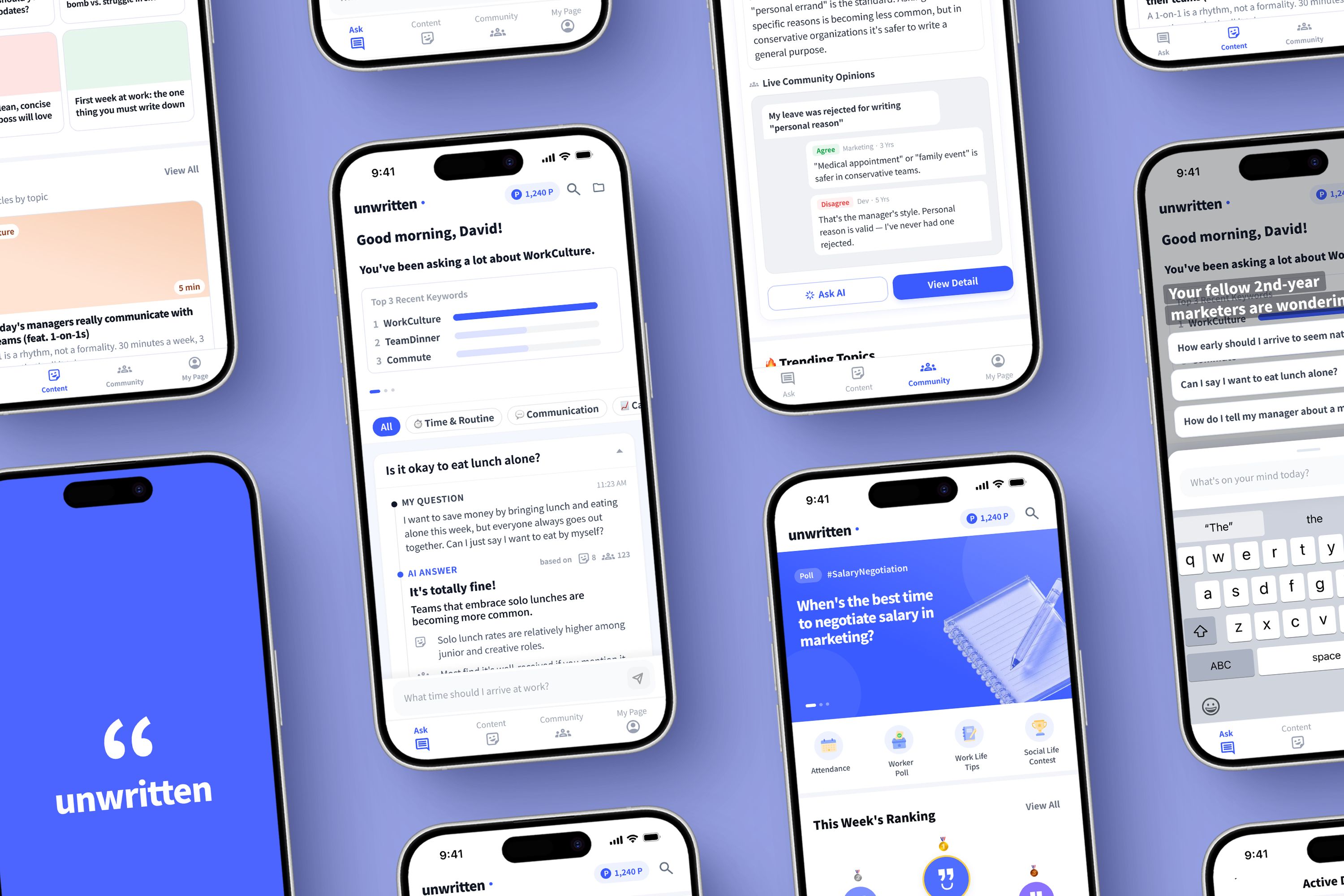
The hardest part wasn't designing the interface, it was figuring out how to research something people don't know they know. Tacit workplace norms are so deeply internalized that asking directly just doesn't work. People would say I don't really have anything special to share, then spend thirty minutes describing unspoken rules in precise detail. That gap forced us to rethink the research method entirely. We used role-play, asking participants to advise a hypothetical newcomer via chat, which bypassed the blind spot. The tension that never fully resolved: people need anonymity to share honestly, but anonymized knowledge loses the specificity that makes it useful. That trade-off sits at the heart of every design decision.
What was your personal highlight in the development process? Was there an aha!-moment, was there a low point?
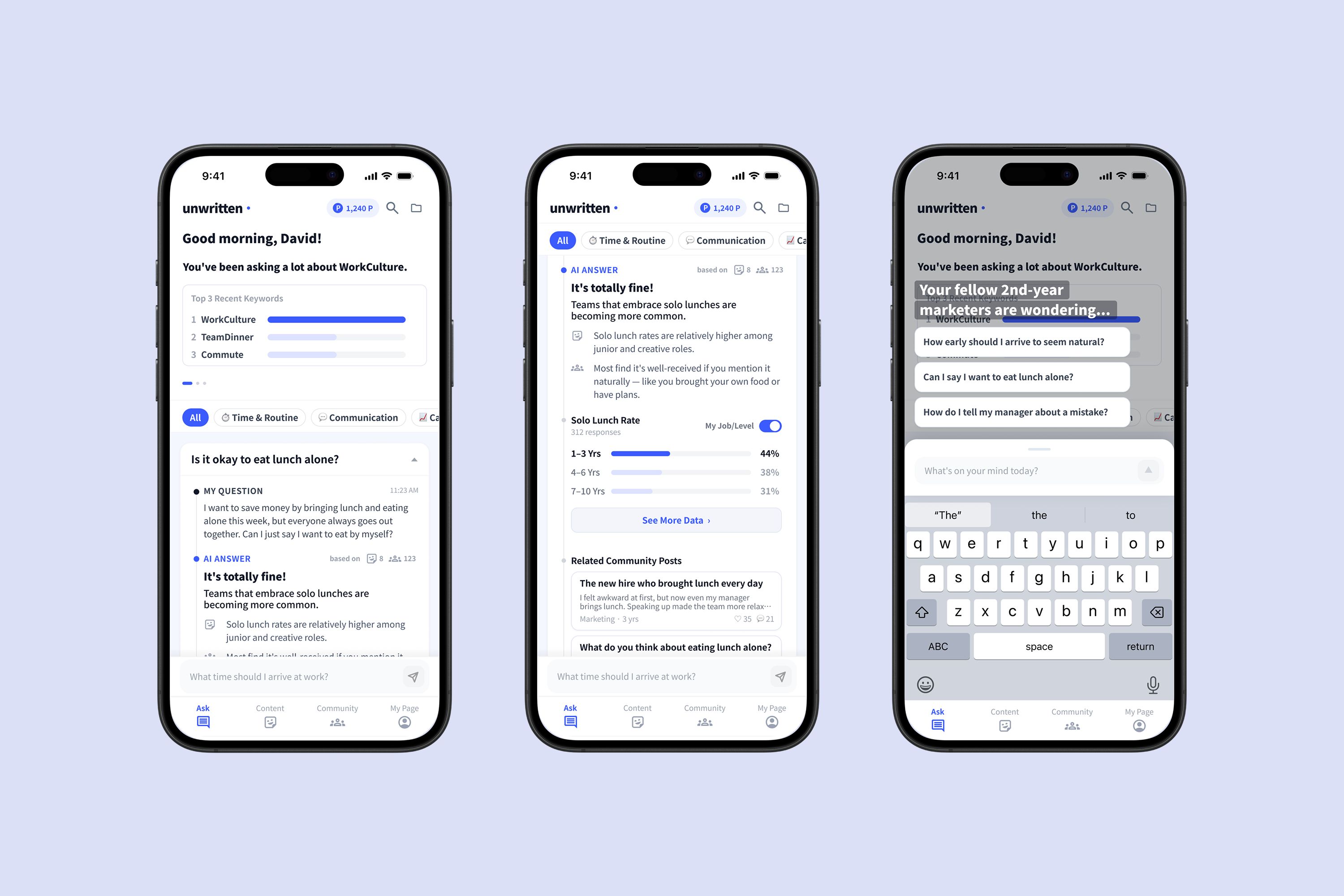
At some point it clicked, workplace problems are a near-perfect use case for AI mediation, because the thing that makes advice useful is exactly the thing people can't share. Your company name, your team dynamics, the specific person you're dealing with. You can't post that publicly. But an AI intermediary can hold that context and filter what gets surfaced based on what actually matches your situation. The harder question was how to show that in the product. Get it wrong and Unwritten just looks like another community app with a chatbot. The answer was making AI's role explicit, real responses it merged and filtered, and copy that tells users: this was chosen for your context, not just the most upvoted response.
Where do you see yourself and the project in the next five years?
Five years from now, we want Unwritten to be the place people open when something happens at work and they don't know how to read it — and feel, when they get there, that someone has been through the same thing before. A living archive where collective experience accumulates rather than disappears. Not a smarter chatbot, but a community that gets more useful the longer it exists.
For us, this is as much about learning to build something people trust with vulnerable, unshareable thoughts as it is about the product. In five years, we see ourselves working on problems in that same space — where human communication breaks down and design has to fill the gap. Unwritten is where we're starting to figure out how to do that.